A massage menu gives you the name of a style. Your hands-on experience comes from the individual movements, their pace, the areas being worked, and the way pressure is adapted to you. Knowing a few of those names can make it easier to describe what you enjoy.
A style is the approach. A technique is a movement.
Swedish massage often combines classic flowing strokes and kneading. Deep tissue describes a more focused approach, while sports bodywork can be shaped around activity. None of those labels means a session must follow an identical routine from person to person.
The guide below introduces common terminology. Names and classifications vary between training systems. It is not a self-treatment manual, a qualification, or a list of every service available at Release.
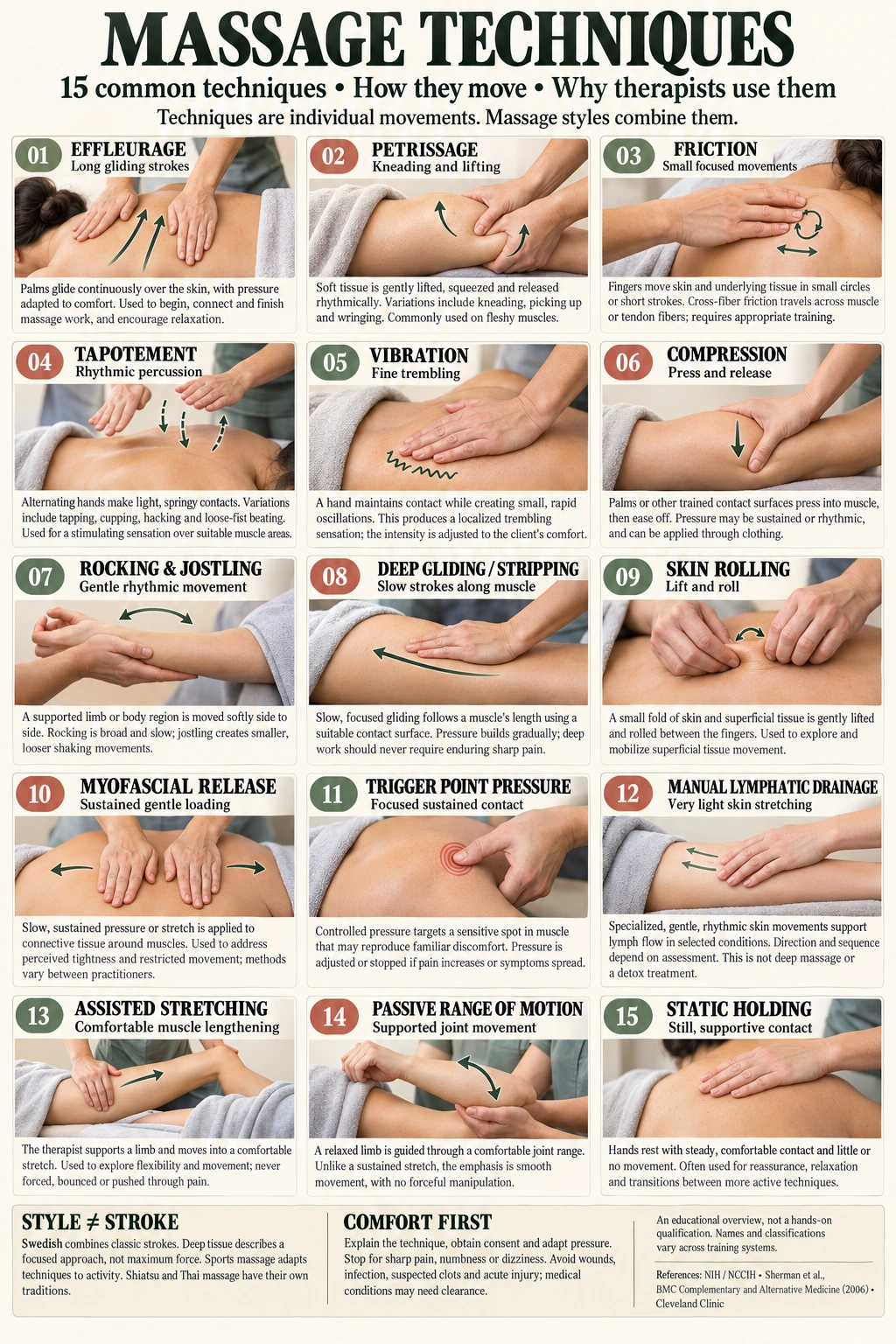
15 movements you may hear named.
01 / Effleurage
Long, gliding strokes connect one area of the body to another. Pressure and speed can be adjusted, making these strokes a familiar part of many Swedish massage sessions.
02 / Petrissage
Kneading, lifting, and gently squeezing soft tissue create a different sensation from gliding strokes. The rhythm is usually steady, with contact adapted to the area.
03 / Friction
Small, focused circles or short strokes work over a limited area. Cross-fibre work is a variation; it is not simply a reason to apply more force.
04 / Tapotement
Rhythmic percussion uses alternating light contacts. Tapping, cupping, and hacking are variations, and the sensation may feel more stimulating than settling.
05 / Vibration
A hand stays in contact while creating small, rapid movements. The result is a fine trembling sensation whose intensity can be adjusted.
06 / Compression
A therapist presses into a muscle and then eases off. Contact may be still or rhythmic, and some compression can be performed through clothing.
07 / Rocking & jostling
A supported limb or area is moved gently. Rocking tends to be broader and slower; jostling uses smaller shaking movements.
08 / Deep gliding / stripping
Slow gliding follows the length of a muscle using an appropriate contact surface. Pressure builds gradually and should not require enduring sharp pain.
09 / Skin rolling
A small fold of skin and superficial tissue is gently lifted and rolled. This feels quite different from kneading a larger area of muscle.
10 / Myofascial release
Sustained pressure or stretch is used around connective tissue and perceived tightness. Methods differ between practitioners; the name does not guarantee a particular outcome.
11 / Trigger point pressure
Focused, sustained contact is directed at a sensitive spot. Comfort and response matter; increasing pain, spreading symptoms, or unusual sensations are reasons to stop and reassess.
12 / Manual lymphatic drainage
A specialised approach uses very light, rhythmic skin movements in a planned sequence. It requires appropriate training and assessment. It is not deep massage or a general “detox” service.
13 / Assisted stretching
The therapist supports a limb and guides it into a comfortable stretch. Consent, support, and staying within a comfortable range matter more than reaching a dramatic position.
14 / Passive range of motion
A relaxed limb is guided through comfortable joint movement. Unlike a held stretch, the emphasis is on smooth movement without forceful manipulation.
15 / Static holding
Steady, comfortable contact with little or no movement gives a session a quieter moment. It can create a gentle transition between more active techniques.
You can describe a feeling instead.
You do not need to request “petrissage” to book a useful session. “Slow and flowing,” “focused on my shoulders,” or “lighter pressure today” tells me something practical. We’ll discuss your preferences and choose the work together.
Comfort remains the guide. Ask what a technique involves before agreeing to it. Stop for sharp pain, numbness, dizziness, or an unexpected reaction. Tell your therapist about relevant health conditions, and seek medical advice when needed.
Curious about what fits your day? Explore the Workday Recovery collection or compare Release’s massage treatments. You bring the questions; I’ll help make the choices clearer.
Sources & further reading
Educational information, not a diagnosis or an individual treatment plan. Published October 24, 2026.